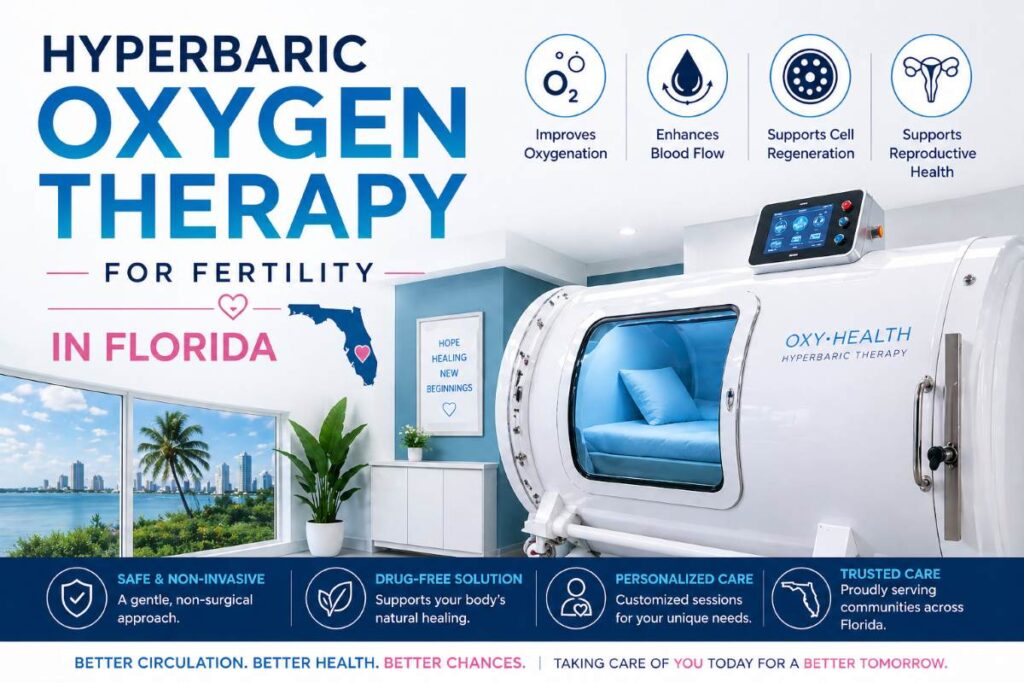

For Florida couples navigating the emotional and physical challenges of infertility, hyperbaric oxygen therapy (HBOT) is emerging as a powerful, evidence-backed adjunctive treatment — improving egg quality, endometrial health, sperm parameters, and IVF success rates without surgery or downtime.
What Is Hyperbaric Oxygen Therapy and How Does It Affect Fertility?
Hyperbaric oxygen therapy (HBOT) is a non-invasive medical treatment in which a patient breathes 100% pure oxygen inside a pressurized chamber set to 1.5–3 times normal atmospheric pressure. This dramatically increases the amount of oxygen dissolved in blood plasma, delivering concentrated oxygen deep into tissues — including the ovaries, uterus, and testes — that are often oxygen-deprived in patients struggling with infertility.
Reproductive success depends fundamentally on oxygen. Ovarian follicle development, endometrial growth, embryo implantation, and sperm production are all oxygen-intensive biological processes. When these tissues are underoxygenated, fertility is directly compromised. HBOT for fertility in Florida addresses this root cause by saturating reproductive tissues with therapeutic levels of oxygen, stimulating healing, new blood vessel formation (angiogenesis), and cellular repair.
Key Mechanism
At 2.0 ATA, HBOT can increase tissue oxygen concentrations by up to 1,200% and significantly elevate VEGF (vascular endothelial growth factor) — the body’s primary trigger for new blood vessel growth. In reproductive tissues, this directly translates to improved ovarian blood flow, thicker endometrium, and better follicular development.
HBOT for Female Fertility: Endometrial Health and Egg Quality
Improving Endometrial Receptivity
A thin or poorly vascularized endometrial lining is one of the most common causes of IVF failure and recurrent implantation failure. HBOT for endometrial receptivity works by increasing blood flow and oxygen delivery to the uterine lining, promoting the thickness and vascularity required for successful embryo implantation.
Clinical Study
A randomized study published in the Journal of Basic Medical Science followed 32 women with unexplained infertility. All participants received HBOT at 2.3 ATA for 70-minute sessions over 7 consecutive days, starting on day 5 of the menstrual cycle. Transvaginal color Doppler confirmed that all 32 women showed measurable improvements in sub-endometrial blood flow, endometrial thickness, and uterine vascularity — significantly improving conditions for conception.
Boosting Egg Quality and Ovarian Reserve
Declining egg quality and poor ovarian reserve are among the most difficult fertility challenges, especially for women over 35. HBOT improves this by revitalizing mitochondrial energy production inside oocytes, reducing the oxidative stress that causes chromosomal errors, and stimulating angiogenesis in the ovary to create a richer blood supply for developing follicles.
A 2025 cohort study in Reproductive Biology and Endocrinology followed 41 women with poor ovarian response (POR) undergoing IVF. Results showed that 4–7 HBOT sessions during ovarian stimulation significantly increased oocyte yield, fertilization rates, embryo quality, and the number of available embryos. Before HBOT, 58.5% of IVF cycles produced no usable embryos — after HBOT, this dropped to just 14.6%.
- Improved oocyte yield — more eggs retrieved per IVF stimulation cycle
- Better embryo quality — higher rates of good-quality blastocysts available for transfer
- Enhanced endometrial receptivity — thicker, more vascular lining for implantation
- Improved ovarian angiogenesis — new blood vessels supporting follicular development
HBOT for Male Fertility: Sperm Quality and Count in Florida
Male factor infertility is responsible for approximately 40–50% of all infertility cases. Low sperm count (oligospermia), poor motility (asthenospermia), abnormal morphology (teratospermia), and sperm DNA fragmentation are the most common issues — and all are directly linked to oxidative stress and inadequate oxygen in testicular tissue.
A landmark systematic review and meta-analysis published in Medical Gas Research (December 2025) synthesized data from 9 randomized controlled trials. It confirmed that HBOT significantly improves sperm survival rate, sperm density, sperm motility, normal sperm morphology, and clinical pregnancy rates when used alongside conventional male infertility treatments. HBOT works by increasing oxygen to the testes, energizing sperm mitochondria for better motility, and reducing the oxidative stress that damages sperm DNA.
HBOT Fertility Protocol in Florida: What to Expect
Florida HBOT centers offering fertility-focused hyperbaric oxygen therapy typically work in coordination with your reproductive endocrinologist to time sessions to your treatment cycle. Here is what patients can generally expect:
- Female IVF support: 4–7 sessions at 2.0–2.4 ATA, aligned with ovarian stimulation (beginning around day 3–5 of the cycle)
- Unexplained female infertility: 7 consecutive daily sessions at 2.3 ATA, starting day 5 of the menstrual cycle
- Male infertility: 20–40 sessions at 2.0–2.4 ATA over 4–8 weeks, followed by repeat semen analysis
Session duration: 60–90 minutes per session; zero downtime required
Florida HBOT fertility clinics are located in Miami, Orlando, Tampa, Fort Lauderdale, Boca Raton, and surrounding areas. When selecting a provider, look for UHMS-certified hyperbaric physicians with documented experience treating fertility patients and a willingness to coordinate directly with your IVF clinic.
Frequently Asked Questions
Yes. Clinical evidence shows HBOT improves fertility in both men and women by increasing oxygen to reproductive tissues. A key study found all 32 women with unexplained infertility showed improved endometrial health after HBOT. A 2025 meta-analysis confirmed significant sperm improvements and increased pregnancy rates. HBOT is most effective when used alongside IVF, IUI, or other conventional fertility treatments.
For IVF support, 4–7 sessions during ovarian stimulation produce the best results. For unexplained female infertility, 7 daily sessions starting day 5 of the cycle improves endometrial health. For male infertility, 20–40 sessions over 4–8 weeks are typically recommended. Your Florida HBOT specialist will tailor a protocol based on your specific diagnosis.
Fertility-related HBOT is an off-label application and is generally not covered by insurance in Florida. Out-of-pocket costs typically range from $150–$450 per session. Many Florida HBOT centers offer fertility package pricing. Always ask about payment plans and multi-session discounts.
Conclusion
Hyperbaric oxygen therapy for fertility in Florida offers compelling, research-backed benefits for both men and women struggling to conceive. Whether you are looking to improve endometrial receptivity, boost egg quality before IVF, address poor ovarian response, or enhance sperm health — HBOT provides a safe, non-invasive pathway to optimize the biological environment for conception.
HBOT is not a replacement for reproductive medicine. It is a powerful adjunctive therapy that, when integrated with IVF, IUI, or other fertility treatments, may significantly improve your chances of a successful pregnancy. The first step is a consultation with a certified hyperbaric physician experienced in fertility protocols in Florida.
Key Takeaways
HBOT improves female fertility through enhanced endometrial blood flow, thicker uterine lining, better egg quality, and IVF outcomes. For men, it significantly improves sperm motility, count, morphology, and pregnancy rates. Evidence-based Florida protocols range from 4–7 sessions for IVF support to 20–40 sessions for male infertility. HBOT is safe, non-invasive, and works best alongside conventional fertility treatments.